
Accomack County Property Value Types
An Accomack County property value can take three forms. A tax assessment is one. A recorded sale price is another, and a market opinion is a third. Virginia's general assessment rule requires real estate to be assessed at 100 percent of fair market value, though the assessor's figure still comes from a county valuation process tied to a set date. CAMA separates land from improvements. It may add a reported sale price, while the deed records the transaction itself, and a current market estimate requires a separate appraisal or analysis.
| Value | What It Is | Where |
|---|---|---|
| Assessed value | County's tax valuation as of the assessment date | Commissioner of the Revenue / CAMA |
| Market value | Estimated exchange value; not a separate sale guarantee | Assessment context or independent appraisal |
| Sale consideration | Price stated for a recorded transaction, if reported | Deed and CAMA transfer fields |
| Land and improvements | Separate components of the total assessed amount | Assessment record |
Each amount carries its own date and basis. A prior sale is not a current offer. A county assessment is not an appraisal prepared for a buyer, and improvement value is only one part of a total. Land-use classification works differently. Qualifying agricultural or forestal land follows a separate statutory route to value. Any comparison should preserve the parcel ID, the transfer date and the legal description so the numbers stay matched.
Accomack County's 100 Percent Assessment Rule
Virginia law tells localities to assess real estate at 100 percent of fair market value. Accomack County follows that standard with a January 1 assessment date. That date matters. A year's tax roll reflects the January 1 snapshot. A sale that closes months later does not appear on it. Keep this in mind when you pull Accomack County property records to compare values across years.
Separate the assessed value from any relief on the account. Senior or disability relief, a disabled-veteran exemption, or land-use assessment for eligible agricultural or forestal parcels can change the tax bill. None of them changes the market basis of the number itself. Use value under the land-use program is not an unrestricted-market estimate. Note the program and status beside the value. Do not treat every tax bill as equivalent.
The property records themselves describe land, main buildings, other improvements and total assessed value. They may add building age, condition, features, depreciation, a photo and a sketch. Those fields explain the county's entry. They do not supply a standalone current appraisal. A market estimate for a sale or financing decision should come from a professional valuation.
Looking Up an Accomack County Property Value
AccoMap is the place to start. You can locate a parcel by address, owner, parcel ID or tax-map number. Record the map ID and legal description. CAMA then lists land, building, other-improvement and total values. If a transfer appears, note the instrument number, recording date and reported sale price, then compare like dates and confirm both records describe the same parcel before drawing a trend.
- Search the address or known parcel key in AccoMap.
- Copy the parcel ID, legal description and assessment components.
- Read the reported transfer date and sale price, then use the instrument number to find the deed.
- Compare annual land books or other parcel records only after matching their dates and descriptions.
- Assessed value
- The county's tax valuation for a parcel and assessment date.
- Market value
- An estimate of likely exchange value under stated conditions.
- Sale consideration
- The price reported for a recorded transaction, not a current offer.
- Land-use value
- A separate value basis for qualifying agricultural or forestal use.
Accomack County Value and Transfer History
Accomack County's annual land books cover 2015 through 2026. They identify owners as of a particular date. The CAMA record can show present and past transfers, instrument numbers, recordation dates and sale prices, allowing a parcel-level comparison over time. The county publishes no town-level value trend. It lists no typical assessment-update lag either. Build a trend from matched parcels and recorded dates instead of one assessment amount alone.
A recorded deed deserves a close read. Compare its stated consideration with the CAMA value and the assessment year. A transfer after January 1 postdates that snapshot. If the legal description changes, a split or combination can make year-to-year comparison misleading, so keep acreage, land and building components, and parcel identifiers with each value.
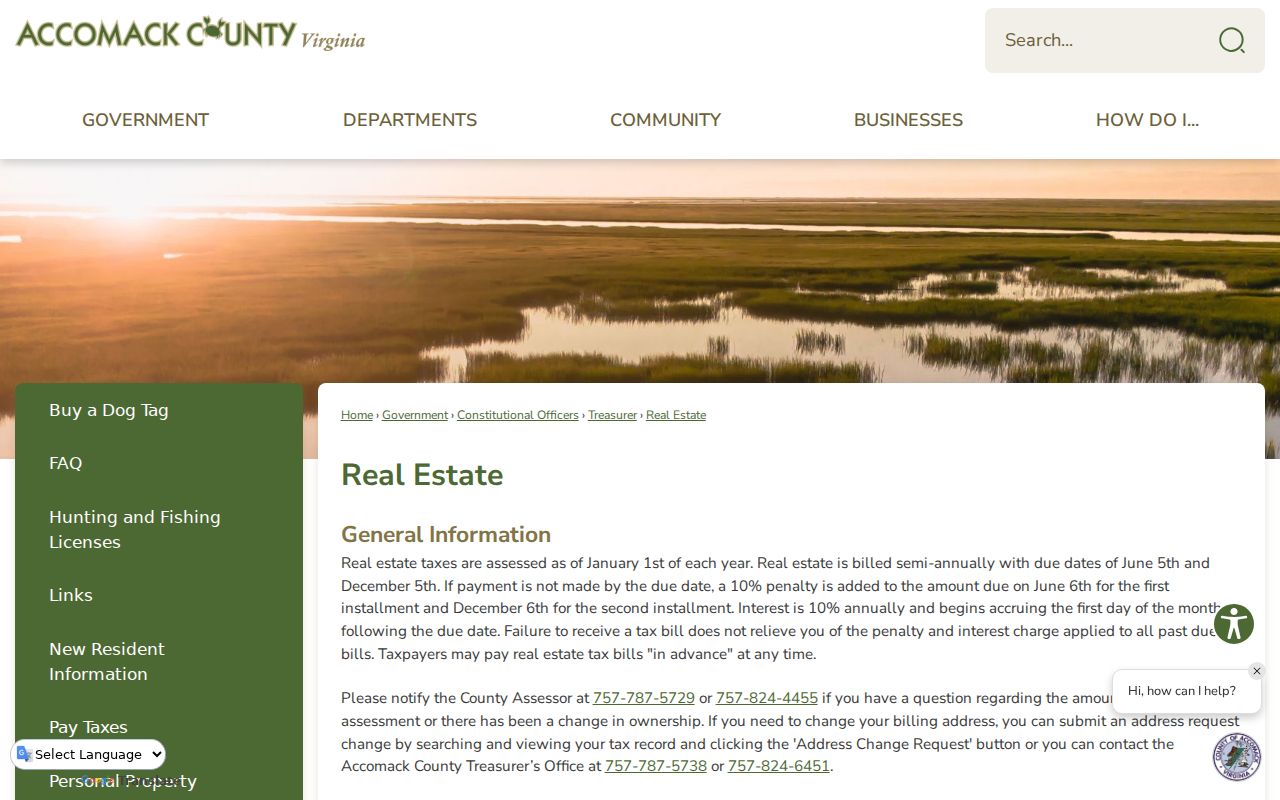
The county's real-estate tax page describes the assessment and tax record context.
Use the county's current records to check the date and meaning of each value.
Accomack County Land and Improvement Values
CAMA describes each Accomack County parcel in layers. The record separates land, the main building, other improvements and a total assessed value. It can include acreage, construction quality, condition, features, building age and depreciation. Those details explain the pieces behind a tax value. They do not show what a buyer would pay. They also miss recent shifts in local demand.
Keep land and improvement values separate when comparing parcels. Value drivers differ widely here. A coastal lot in a different flood setting and a renovated historic house do not share the same value forces. A broad agricultural tract responds to yet other pressures. The CAMA sketch and photograph clarify what is on file. Field condition or legal status needs direct review. Pair every number with its parcel ID and assessment date.
Accomack County Market Evidence and Tax Values
A sale price tells you about one deal on one day. It is not a trend. The recorded deed, or the CAMA transfer field, may carry a number when a price was reported. But Accomack County publishes no official town-level appreciation series. To compare well, set parcel acreage beside land and improvement components. Weigh the neighborhood, and check the deed's recording date. One sale never makes a countywide rate.
Accomack's general assessment follows Virginia's full-market-value rule. Land in agricultural or forestal use can travel a separate statutory path. Either way, these values exist for tax purposes. The bill, exemption and filing steps sit with the Accomack County property tax records. A current market opinion calls for a qualified appraisal.
Accomack County Value Comparisons by Setting
Accomack County holds farmland, marsh, forest, mainland towns, and barrier-island parcels. Two properties with nearly equal assessed totals can still be poor comparables. Location, acreage, road frontage, water access, flood exposure, and building features all pull values apart. Chincoteague carries a coastal, tourism-driven market unlike a large agricultural tract near Parksley. Onancock adds its historic core and creek proximity to the mix. No recent town-level appreciation rate or county revaluation schedule is published.
When you compare, break values into land and improvement parts. Check the legal description, parcel area, and transfer date. For a shore-side parcel, weigh flood and zoning context. An AccoMap layer is not a value estimate, though. Use a qualified appraiser for a current market opinion. Use the deed for the price actually recorded in a past sale.
What an Accomack County Assessment Cannot Prove
An Accomack County assessment is a tax value. It is not a promise of sale price or a personal appraisal. It cannot prove that improvements were legally permitted. It cannot prove that a boundary sits where a map draws it. It cannot prove that the owner of record can convey clear title. A CAMA transfer field is only a lead; the deed supplies the recorded instrument. A GIS line is general information. Each property records source plays a narrow role. None substitutes for the professional record that fits your decision.
Value vs price. Accomack County assessed value is for taxation and is not what a parcel will necessarily sell for. Obtain a qualified appraisal when a current market opinion is needed.